Tuesday, July 5, 2011

Chapter 6. Back to San Francisco from Casper

We travelled by schooner to San Francisco - my last ocean voyage. At that time the city seemed to be overrun by Chinamen - crowds of them on the streets carrying loads on a pole across their shoulders just as shown in pictures of China. They were not allowed on the side walks with these loads so they had to take to the streets along with the pack mules and other animals.

Before continuing with grandfather's history here are some pictures of San Francisco circa 1870 to give you some idea of what the city looked like when with his parents and brothers and sisters they returned from Casper
Grandad's brother Alex took up pulling teeth in SF probably in a shop something like the one in the picture below or in a barber shop, a common combination back then. When I met him when he was 93 he had retired as a wealthy dentist in New York.


Before leaving California history I might just add that father never went down to the San Joaquin Valley again to look at the ranch for which he had paid $1000 (17,000 2010 dollars)as at that time it had been abandoned as being too dry for farming and only fit for grazing cattle. In later years this area was irrigated and the finest peach, plum and apricot orchards of the state were located there. One of the richest oil fields was also found on this section of ours which formed part of what is known as the Bakersfield Oil field. If we had but known this and stuck with it we might now be ranked with Rockefeller and Sinclair as millionaire oil barons.

Sunday, July 3, 2011

Chapter 5. Life as a Young Boy in Casper, California

The first year we lived in a house on a side street on the outskirts of the town; our nearest neighbour was the constable Tom Pepper who was married to a squaw who seemed to get a licking from him every day judging from the row they made.

One night the foreman of the mill came up to our house and much excited because he had been shot at when going home. He showed us where the bullet had gone through the top of his hat and got dad to go with him to get Tom Pepper to arrest the man he thought had done the shooting but Tom refused to go saying that as long as he wasn't hurt he could do nothing - and that was all there was about it.

On the main corner of our street and the main street there was a saloon kept by a man named George Heldt who was also married to a squaw whose name was "Wildcat" who had the fanciest tattoo marks that could be imagined - red, blue and many other colours in fancy lines all over her face, arms and hands - it made her look like a real wildcat and we all took care to give her a wide berth when we saw her around as her temper was as savage as she looked. A couple of years later Heltd divorced her (Indian fashion)and married a white woman but within a month or so Wildcat got hold of him and scratched and clawed him so badly that he was laid up for weeks.

There were many Indians of the Digger Tribe living along the coast from one of whom I got a real Indian Bow and Arrows of which I was very proud both of ownership and skills. One time while playing with it a bigger boy, Johnny Moss, tried to take it from me upon which I threatened to shoot him, as he kept coming up to me. I let fly an arrow and struck him in the eye. I could not see how badly he was hurt as he started for home crying out that I had put his eye out. That evening he came with his father to the house after me. I don't know what they wanted to do with me or to me but father took my part and for a time it looked like as though they would have a fight themselves, but it ended by them going away without satisfaction. I expected to be in for something from father after but all I got was an order to break up that bow - which I was very pleased to do and so closed my career as a Wild Indian.

As school was closed during the rainy season (December until April) our second winter we attended a private school kept by the Reverend John Ross, a Baptist Minister formerly of our church in Thurso. He ran his school in a manner different to what we had been accustomed to and we all liked attending, but all that now lingers in my memory of what he had taught was the Kings of Wars of Judea and Israel and the heroes of Ancient Greece. today he would be classified as a specialist in Ancient History and beyond the capacity of then pupils.

At that time Mr Ross preached to three non denominational churches twenty five miles apart, Casper being the middle one. Horse back was the only mode of travel on Sunday, with stages up and down the coast from Noyo to Petaluma one trip each way once a week. Most of the travelling was by sailing schooners taking anywhere from twenty four hours to a week to make the trip to San Francisco depending on how the wind was.

Our second year in Casper we moved from Tom Peppers neighbourhood to a house, the verandah of which was closed in by the most beautiful Roses and Fuchsias that could be found around which bright coloured humming birds not much larger than butterflies were perpetually buzzing.

At this time we kept a cow and it was my charge to milk her, also drive her out to pasture and bring her in at night - an odious task as it meant being there morning and evening. It was a great relief to me although a loss to the family when she at last fell over the cliffs and broke her neck.

The last year or so in Casper seemed to be unlucky as father was laid up with a felon on his finger which had to be operated on leaving a crooked withered first joint on his right hand index finger. Shortly after recoverig from this operation he was again laid up with an infected jaw bone, had to go doawn to San Francisco where he was operated on by an army doctor. There was no such thing in those days as a local anesthetic and his trouble being in the head it would not be safe to give chloroform so he was laid out on an operating table with a man holding his feet another holding hi arms while a third held his head during the half hour or more that the doctor opened up the jaw bone ,chipped and scraped off all the infected bone and then sewed it up, where through it all father was more dead than alive; however he pulled through and lived until he was 93.

Mother was also in poor health at this time and as her people at home always wanting them to return it was finally decided to sell off and do so. During this period of stress I had gone to work in the sawmill. My first job was packing shingles, later marking lumber. our hours were starting work at 5.15 AM, then twenty minutes for breakfast at 6, a half hour for dinner at noon and finishing work at 6.45 PM - quite a contrast to the six day week and eight hour day now advocated.

Chapter 4. Leaving Hard Times and Sailing up to Casper

This farm investment and crop failure just about broke father so in order to raise money for the next year's seeding we moved up to Casper - Mendocino County. From San Francisco we took passage in a schooner taking two or three days to make the trip as the winds were contrary. When we got to Casper we were loaded by putting two or three at a time into a big bucket made out of a half barrel, then hoisted up from the schooner and swung ashore. Casper was a very small town, it's only industry being a sawmill and the taking out logs to supply the mill.
These logs were all Redwood which is something like our Cedar but of an immense size. The stump of one of the cut trees near one of the logging camps and cut off about twelve feet above the ground measured fourteen feet in diameter. At a picnic held there one fourth of July this stump was smoothed off, a railing put around it and a dance held on it. I was too young to take part in the dance but was among those who were there as spectators. Father had a piece of bark of one of those Redwood trees that was fourteen inches thick.

Casper was right on the Pacific with nothing but ocean between it and China.

It was almost a daily sight to see whales spouting or sometimes laying like a big black log in the ocean outside our little harbour.At times we boys would catch salmon by throwing ourselves on them when they would be stranded in little pools left on the beach when the tide went out. We also spent a lot of time gathering Mussels,Abalone,and the other shellfish among the rocks along the coast when the tide was out, but we always had to watch that we would not get caught when the tide was coming in as the water would the raise about six feet before it reached it's height. Mussels are a shellfish something like a clam and are found in bunches attached to the rocks above the water at low tide and we would scrape them off with an old chisel or an old bar of iron throw them into a pot without any water and put them there to boil and soon there would be enough water in the pot to cover them. When cooked the shells opened so that the meat would come out red and juicy. They were considered a delicacy equal to oysters but only fit to eat in he months with an R in them.

Sunday, June 19, 2011

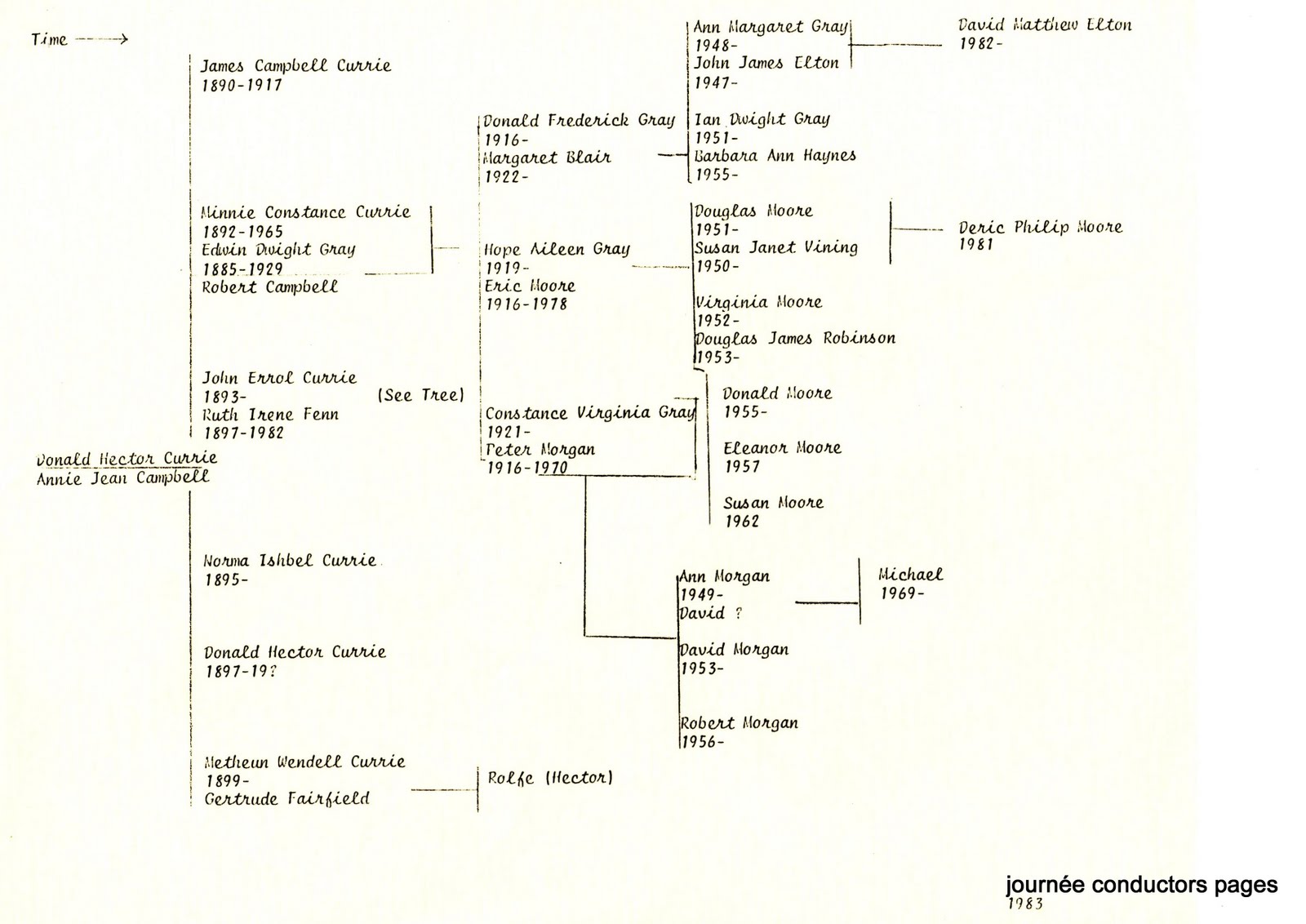
Pictures and Family Trees

Grandfather, his mother and father, brothers and sisters

Standing: Alex Currie, Donald Hector Currie, Dorothy Currie; Seated: May Currie McLauren, May McLean Currie, John Currie, James Currie, Jessie Currie MacDonald

.
Best guess: photo taken around 1885.
1915 - From left to right: Jack Currie  (my father), Jim Currie, Donald Hector Currie (father of sons), Meth Currie, Hector Currie


Chapter 3. Voyage to California and settling in

About all I can remember of Aspinwall was the grass-roofed low houses and the natives wearing nothing but very short shorts and peddling baskets of brown sweet bread or cakes which they carried on their heads without touching them with their hands.

After a real dinner at the hotel we took a train across the isthmus to the town of Panama on the Pacific side. The railroad all the way across ran through a regular tropical jungle; palms and ferns so thick you could not see anything except every once in a while we would pass a native village hut where all the men, women and children were dressed "au natural " not a stitch on any of them.

We arrived in Panama some time after dark and unloaded from the train on to "Lighters"- something like a big decked scow and taken out to the STD ship "Montana" which was anchored about a mile from the town.


There was no chance to see anything of Panama, only the lights seen from the ship. The Montana was just the same as the Arizona; about the only difference that they had a big Chinaman in charge of the water tank instead of a white sailor as on the Arizona. If on either vessel you wanted a drink of water you had to go to this tank and ask the man in charge and and he would turn on the tap for just so much, and not always when you asked either. For washing, the ocean water had to do.

Another change was that in place of cattle we had a lot of sea turtles, over two feet across the shell and with flippers instead of legs and claws like our turtles. As they were fenced in there was no disturbance from them.

Four weeks from the day we left New York we arrived in San Francisco and the next day took a steamer up the Sacramento River to Rio Vista where father's father, mother, brothers and two sisters were living on farms about six miles back from the river in what was called the Sacramento Valley. This valley wasn't level but hilly without a tree anywhere. We lived there at grandfather's and uncle Menzies who live nearby had four boys in the family with whom I would often go out hunting Jack Rabbits. There Jack Rabbits were almost as big as sheep with ears that stood straight up and how they could run. We had a big dog that could run them down and catch them for us.

After we settled down Dollie, Jessie and I started going to school again upon which I found that I had forgotten those multiplication tables that I had taken so many bit hinge to learn a few months before. Out teacher in this school was what would today be called a "faddish" as if any of the children showed signs of neglecting their toilets at home she would take a fine comb and comb their hair -if any game was found they would get the rawhide -no switches grew there and glad to say one of our family never had to be examined. She also used to drill us for ten minutes before noon in callisthenics -arms, legs, head and body all had their share of drill which we found the hardest part of our school life.

While here father and his brother-in-law, Dan Stewart, went down to the San Joaquin valley where they each bought a half section of land and put a crop of wheat on it, but as that happened to be a dry year no rain fell in the valley and their crop was a failure.

Monday, June 13, 2011

Chapter 2. Moving to California, first stop Panama

About the first of July 1869 we were packed up and off to California, going first to New York and then taking a Steamship for Aspinwall, Isthmus of Panama. Before leaving New York, mother made two canvas belts into which she sewed all our money which had been changed into gold, and father and mother each wore one of these belts inside their clothes.

The steamship "Arizona"upon which we took passage was a big three deck side-wheeler (it was the days before the propeller came into use) and was crowded to the limit by people in search of fortune in Golden California as this was only twenty years after the first discovery of gold in California and the general impression seemed to be that in California gold could be picked up anywhere once you got there.

Through the glowing description of the steamship agents and also influenced by the low cost we went third class or steerage as it really was, so all the women and children were stowed away in the forward end of the vessel in the lower deck which was closed tight at night so that you could neither get in or out and no men were allowed in there. On the middle deck just above the women's quarters were the men's sleeping quarters which were canvas stretched three rows high and which was taken down during the daytime when it was made into a dining room by letting down long tables that at night was hooked up to the ceiling but let down as hanging tables that would not spill when the ship tossed and rolled in the ocean waves.

The forward part of this dining room - without any partitions either - was filled with Cattle ; one day about noon a big long-horned steer got loose and went on a rampage tossing the tables and spilling everything all over the place; as the dishes were all tin none were broken.

Our Bill of Fare was "Hard Jack and Salt Horse". The Hard Jack was sea biscuits about the size of a saucer so hard that it took a hammer to break them. We had to soak them in tea to bite them. The Salt Horse was corned beef (and it was said horse meat too) so dry and salty that boiling it did not take the salt taste out. This without either milk or sugar was the fare for each meal day after day. The children and I think the women also got one slice of white bread once a day - some of us children used to hang around the kitchen where cabin passenger meals were prepared and the cooks would occasionally pass us out a piece of pie or a bun which was a great treat.

The men always ate at the first table - that is the first setting, then the women and children at a second and third setting - there were no seats so everyone had to stand up at the table and they were hung so high that I just could get my head above them - as a result the mothers generally had to feed their flock by handing down to them what there was, mostly Hard Jack that had been softened in tea.

After breakfast everyone had to go up to the upper deck where there were seats and also room to walk around and enjoy the fresh sea breezes. When passing Cape Hatteras there was a regular storm blowing when everyone was kept below with most of them seasick -several hundred women and children crowded into close quarters without any fresh air and sea sick in the bargain - however none died.


A few days after passing Cape Hatteras we got into the Gulf of Mexico, and the suffering from the heat began. At night below decks was just smothering and most of us boys used to stow ourselves away on the upper deck before being ordered below at night, hiding behind the smokestacks or under the life boats, and then pass the nights where it was cool. I think the sailors sympathized with us and they never tried to chase us down although they must have seen us in hiding.

It took about two weeks sailing from New York to Aspinwall, where we landed one morning and stayed until noon.

Friday, June 10, 2011

Chapter 1. Abraham Lincoln has been shot

Introduction: My grandfather, Donald Hector Currie (1860 - 1956), was born on a rural homestead in the Ottawa Valley. Late in life he decided to write his history and has left 55 handwritten pages of his memories from 1860 to 1911. I have left it unedited just as he has written it. It is quite a remarkable story that I will leave you to judge for yourself. This was the era of the horse and buggy and oil lamp. The telephone, the light bulb and phonograph invented in the late 1870's weren't in common use until much later and it was the turn of the century before they arrived in the small towns along with the silver screen.

If you have any insights or comments please make use of the space for comments at the end of each chapter.


Abe Lincoln
As a test of memory and expression of same I have now set out to put down some of those recollections for the entertainment of children and grandchildren who might be interested.

My earliest recollection was that of hearing discussed the assassination of President Lincoln and Johnson succeeding him as President. This was in a conversation between my mother and her Aunt Sally and at the time I thought it referred to some neighbour of hers of that name.

I started going to school when six years old and on the way had to pass a farm where they kept a big flock of geese that always seemed to be on the road and would chase my sister Dolly and myself and scare us nearly to death with their hissing and wing flapping.

The school house was small log building with desks around the two sides and made of boards fastened to the walls like shelves only slanted. The seats were long benches without backs, as I remember well, were too high for my feet to reach the floor. I had a big dog that accompanied us to school and lay under my seat and I would rest my feet on his back. The teacher was an old Scotchman of whom my only recollection is that he talked in Gaelic and Latin and I guess paid but little attention to the small children as I can't remember anything then learned.

At that time we were living on a bush farm at the Western end of the settlement; most of the farm still had to be cleared; that is the trees cut down and burned before any crops could be put in. One time when I was out with my mother picking berries we nearly stepped on a bear when crossing a log. Before I really knew what it was mother had dropped her pail of berries, picked me up and streaked for home. The bear did not follow. I imagine he found the pail of berries more to his liking.

A year or so after this our house caught fire, and as father was away at the time, and no neighbours nearby it burned to the ground with but little clothing and furniture saved.

After the fire we moved down to Grandfather Maclean's** old homestead, a big log house with clapboards over the logs and painted white. It had a big fireplace that took up almost all one end of the house which was all they had for both cooking and heating. In my day this had been built in* and stairs took its place. The heating stove in the living room was a big two story box stove that took three foot long sticks of wood and warmed up the whole house. The windows were large with small panes of glass about 6 inches by 8 inches in each. It was an open house and kept hat way.

In the winter there would always be calls from French beggars who would come with their bag for a dish of flour or oatmeal, or a piece of meat. I remember one day we had an old Scotch bachelor who lived at the other end of the settlement  who came for dinner or supper. After the first course of meat and potatoes a big bowl of preserves was passed to him first, the usual thing being that the guest would help himself to as much as he wanted then then pass it along to others. in this case however he our guest said, "this o'er much for me" and set it down in front of him and ate the whole thing - much to our disappointment as we got none that time.

I attended the same school from grandfathers as before but this time had a lady teacher - a second cousin- who boarded with us and made my life miserable at home as well as in school. She would make me learn my multiplication tables at home and hear them before she would let me go to bed. If forgotten when I was called on to say them in school then the birch switch vigorously applied, and to add insult to injury would send me out to get a switch with orders to get a big one.

It was in June 1869 *** that we packed up and left for California and the joy of leaving this teacher was more than the sorrow of parting with others.

* enclosed

** Donald Maclean (1786 - 1879), his grandfather on his mother's side emigrated from Scotland in 1829

*** he was 9 years old when he left for California